
With water scarcity being a major issue in Australia and around the world, desalination creates a reliable water supply not dependent upon rain. This incredible technology is now used by many countries to help create a sustainable water source.
But what is desalination? The simple science behind the desalination process is that it removes mineral components, primarily salt, from saline water. Read on to discover whether desalinated water is truly the sustainable source we have been hoping for and what else there is to consider.
Why is desalination important?
Desalination is important because it provides a reliable source of fresh water that doesn’t depend on rainfall. As climate change drives longer droughts and more unpredictable weather, coastal communities can use seawater to secure drinking supplies and reduce pressure on rivers and dams.
It also supports growing populations in water-stressed regions where traditional sources can’t meet demand. By diversifying water supply, desalination strengthens long-term water security and resilience.
Is it safe to drink desalinated water?
Desalinated water is safe. All drinking water produced by desalination plants must meet strict quality guidelines. In Australia, these are set by the stringent Australian Drinking Water Guidelines (2011), and many desalination plants are fitted with delivery points so that water authorities may regularly monitor water quality.
Desalinated water is still treated with fluoride, chlorine and other chemicals. These have their own set of issues, including affecting the taste and balance of your water, as well as potential side effects that are damaging to your health, such as electrolyte abnormalities from demineralised water.
Add to this the disinfectants that are put into our water to counteract the bugs, bacteria and organic matter in water pipes and you’re left with impure water and water devoid of beneficial minerals needed to hydrate.

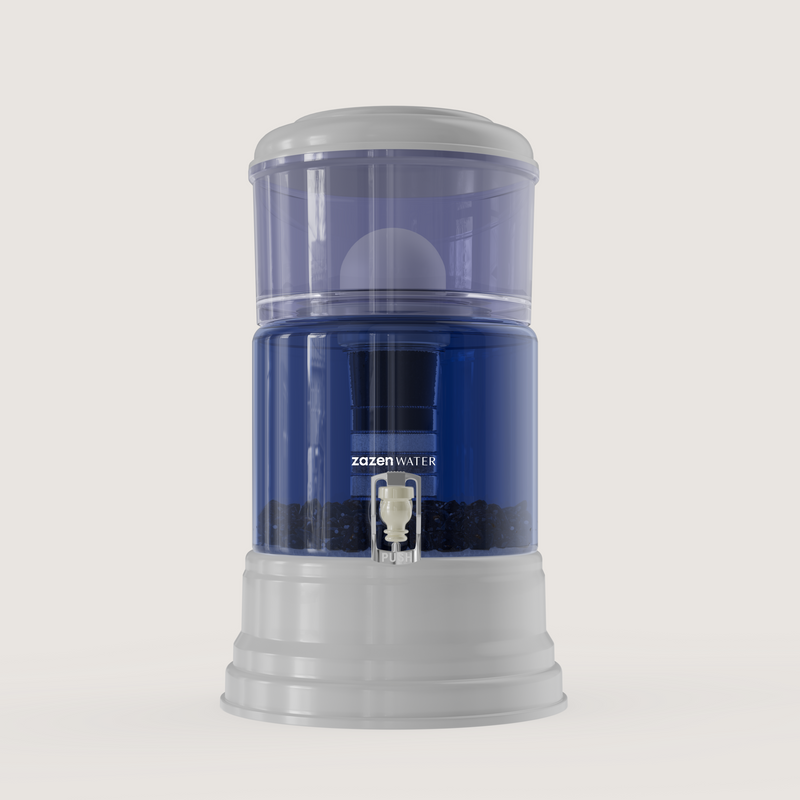
To avoid harmful repercussions, consider choosing an effective benchtop water filter to reduce fluoride, chlorine, nasty chemicals, heavy metals and contaminants from drinking water. As well as the added benefit of using natural mineral stones to replenish the beneficial minerals (magnesium, potassium, chloride and sodium) which are essential in your drinking water for cellular hydration.
What is the desalination process?
Australia has severe issues with water scarcity, with many regions lacking any freshwater supply at all, so as a country we are at the forefront of desalination. Currently Australia has over 30 desalination plants, with every state in Australia now using desalination plants to help boost water supply.
Australia has desalination plants that follow these basic water treatment processes:
- Coagulation: Chemicals (like aluminium sulfate) are added to neutralise particles.
- Flocculation: Gentle mixing causes them to bind together into larger, heavier particles called "floc".
- Sedimentation: Water flows into basins where the heavy floc settles to the bottom as sludge, which is removed.
- Filtration: Water passes through filters composed of sand, gravel, and sometimes activated carbon to remove remaining microscopic particles and impurities, and
- Disinfection of water: Chlorine, ozone, or UV light is added to destroy harmful bacteria, viruses, and parasites.
This turns seawater into drinkable water, which is fantastic. The trouble is, this process alters the natural chemistry of the water, stripping it of beneficial minerals and pumping it with chlorine and many other chemicals. These minerals are removed through the process of reverse osmosis because their molecules are larger than water, meaning the much-needed magnesium, calcium, iron and more might not be present in your drinking water.

How does desalination work?
Seawater contains around 130g of salt per gallon. Desalination reduces these salt levels to well below 2g per gallon, the limit for safe human consumption. This desalination process is conducted using two main methods: distillation and reverse osmosis.
Since the 1950s, reverse osmosis has replaced distillation as the primary method of desalination. In simple terms, reverse osmosis forces seawater through a semipermeable filter membrane at high pressure, allowing water molecules to pass through but leaving the larger salt molecules (and chemicals) behind.
For decades, the major hurdle for reverse osmosis was its cost. However, as technology has proliferated in recent times, seawater reverse osmosis has become more affordable, and thus a much more viable, attractive alternative to distillation.
The pros and cons of desalination
Providing water to the predicted 10 billion people expected to be alive in 2050 is one of the biggest challenges of the 21st century. With water use growing twice as fast as population growth, it's causing more and more communities to suffer water shortages already. This drives the demand (and therefore prices) for freshwater supplies higher, making desalination increasingly attractive – but it's not without its drawbacks.

Desalination could help manage the climate crisis
Providing a climate-independent source of water for critical human needs and economic development (such as agriculture), and providing water security against the effects of climate change, a growing population and drought, are the main desalination advantages.
Desalination works best in countries where rainfall is low, there's coastlines ideally close to major cities where demand is highest, there's access to cheap energy and wealth to invest in and maintain desalination plants.
At present, both the reverse osmosis and distillation desalination processes use a lot more energy, and thus produce a lot more greenhouse gases, than traditional water treatment methods.

However, it's an expensive process
Reverse osmosis requires large amounts of energy to generate the high pressure that forces the water through the filter. Current methods require about 14 kilowatt-hours of energy to produce 1,000 gallons of desalinated seawater.
The increased energy demand means that desalination is more expensive than traditional water treatment methods too. Depending on local energy prices, 1,000 gallons of desalinated seawater can cost around $3 or $4 USD. By comparison, large-scale municipal seawater desalination projects in Australia cost approximately $1-$4 per kilolitre, with energy use representing 50-70% of total operating costs.
This sounds affordable but is often more expensive than pumping water out of the ground or importing it. The high cost of desalination also means that developing countries that would benefit greatly from desalination simply cannot afford the infrastructure.
Costs and logistical issues are then further compounded if desalination plants are a long distance from populated areas, as this requires long water pipes to be built and high volumes of water to be transported over large distances.
There's an environmental cost too
The environmental cost of desalination is heightened when factoring in the very salty, slushy brine, the by-product of membrane desalination. Roughly 142 million cubic metres (equivalent to 56,800 Olympic swimming pools) is created and returned to the sea every day, together with chemicals used during the desalination process.
Due to its dense concentration, this brine sinks and spreads along the seafloor, where it can interfere with entire marine ecosystems. As a pollutant, it must be disposed of carefully.

Many other Australian desalination plants are also powered by accredited ‘Green Power’, such as wind energy. But while this is beneficial to the environment, it can result in a significant increase in operating costs, due to the premium attached to renewable energy. But, as renewable energy becomes more affordable, desalination plants should too.
Get fresh, remineralised water at home with a zazen alkaline water system
Now that we've answered the question of 'what is desalination', it's important to note that it's not just limited to industrial, large-scale plants. In fact, you can desalinate water at home, although these have a number of limitations. There are a number of home water distillation systems that imitate desalination plant processes that can provide contaminant-free, drinkable water from seawater. However, these types of systems are often very expensive and critically lack the beneficial minerals required to hydrate.
For fresh drinking water at home enhanced with with electrolytes and key minerals to keep you hydrated and functioning at your fullest, explore the zazen Alkaline Water System. Designed to return important nutrients to water via a 10-stage filtration process, our system is easy to set up and simple to use, whether you're at home, the office or at school. Enjoy the health benefits of water, just as mother nature intended it.